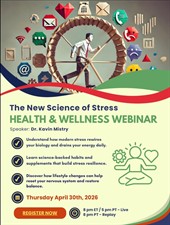
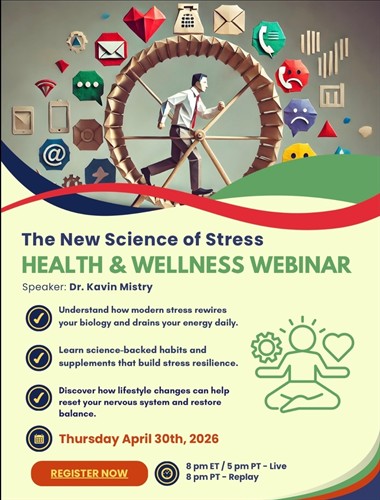
HEALTH & WELLBEING SEMINAR: The Science of Stress

Date and Time
Thursday Apr 30, 2026
7:00 PM - 8:00 PM CDT
April 30th, 2026 : 7pm - 8pm
Location
Zoom Registration Link:
https://us06web.zoom.us/meeting/register/rbe0WDtTQNiK49RQJDqk8w#/registration
Fees/Admission
Free
Contact Information
Priyanka Shivpuri
Send Email
Description
The Death of Attention: The Fight to Reclaim Your Mind in the Age of AI

The Aligned Life | March 2026
There is a quiet crisis unfolding.
Not in hospitals. Not in boardrooms. But in the space between your thoughts.
The average knowledge worker now switches tasks every 47 seconds. The average attention span hovers around 8 seconds. And we are building the most intelligent machines in history.
The real question is not whether AI is getting smarter.
It is whether we are becoming less human.Because attention is not just a productivity tool. It is the gateway to consciousness, creativity, and meaning.
And right now, it is under attack.
What Attention Really Is (And Why It Matters)
Attention is not a single function. It is a networked process involving multiple brain systems working in synchrony.
At its core, attention is the brain’s ability to select what matters and ignore what does not.
Three primary systems drive this:
1. The Dorsal Attention Network (DAN)
- Goal-directed, focused attention
- Anchored in the frontal eye fields and intraparietal sulcus
- Activated when you are deeply engaged in a task
2. The Ventral Attention Network (VAN)
- Stimulus-driven, reactive attention
- Centered in the temporoparietal junction (TPJ) and ventral frontal cortex
- Activated when something novel or distracting appears
3. The Default Mode Network (DMN)
- Mind-wandering, self-referential thinking
- Includes the medial prefrontal cortex and posterior cingulate cortex
- Active when you are not focused externally
When functioning optimally, these systems dance together.
- DAN sustains focus
- VAN alerts you to important changes
- DMN allows reflection and creativity
But in the modern world, this balance is breaking.
The Hijacking of Attention
Social media platforms are not neutral tools.
They are precision-engineered attention traps.
Every notification, scroll, and swipe is designed to activate the dopaminergic reward system, particularly:
- Ventral tegmental area (VTA)
- Nucleus accumbens
- Prefrontal cortex
This creates a loop:
Novelty → Dopamine → Reward → Craving → Repeat
Over time, three things happen:
1. Attentional Fragmentation
Your brain becomes trained to expect constant novelty. Sustained focus feels uncomfortable.
2. Prefrontal Cortex Fatigue
The prefrontal cortex, responsible for executive control, becomes overloaded. Decision-making and focus decline.
3. Default Mode Overactivation
Instead of restorative mind-wandering, the DMN becomes tied to anxiety, rumination, and comparison.
The result?
A brain that is constantly stimulated but rarely satisfied.The Neuroscience of Deep Focus
Deep attention is not just a mental state. It is a neurobiological event.
When you enter deep focus:
- The prefrontal cortex becomes highly coordinated
- The anterior cingulate cortex (ACC) stabilizes attention
- The thalamus filters irrelevant sensory input
- Neural oscillations (especially gamma waves) synchronize across regions
This is what Cal Newport calls Deep Work.
But neuroscience calls it something more powerful:
Neural coherence
This is where insight happens. This is where innovation lives. This is where mastery is born.
And it is becoming increasingly rare.
Rebuilding Attention in a Distracted World
If attention has been eroded, it can also be rebuilt.
Like muscle. Like endurance. Like identity.
Here are evidence-based strategies grounded in neuroscience:
1. Breath Watching (Anapanasati)
Simple. Ancient. Profound.
Observing the breath activates:
- Insula (interoceptive awareness)
- Anterior cingulate cortex (attention control)
- Prefrontal cortex (executive regulation)
Regular practice has been shown to:
- Improve sustained attention
- Reduce mind wandering
- Enhance emotional regulation
Protocol:
- 5–10 minutes daily
- Focus on natural breath
- When distracted, gently return
This is not just meditation.
This is attention training.
2. Adult Coloring and Analog Focus
At first glance, it seems trivial.
It is not.
Activities like adult coloring books:
- Engage visuospatial networks
- Reduce amygdala-driven stress
- Promote flow states
They provide a low-stimulation, high-engagement focus that retrains the brain away from rapid dopamine spikes.
Think of it as:
Rehabilitation for a distracted brain
3. Monotasking as a Skill
Multitasking is a myth.
The brain is switching, not doing.
Each switch incurs a cognitive cost, mediated by the prefrontal cortex.
Strategy:
- Work in 25–50 minute blocks
- Single task only
- No notifications
Over time, this strengthens the dorsal attention network
4. Dopamine Fasting (Strategic, Not Extreme)
You do not need to eliminate pleasure.
You need to rebalance it.
Reduce:
- Constant scrolling
- Notification checking
- Passive consumption
Replace with:
- Reading
- Writing
- Thinking
This restores sensitivity in the reward system.
5. Nature and the Attention Restoration Theory
Exposure to nature has been shown to:
- Reduce mental fatigue
- Restore directed attention
- Decrease activity in stress-related brain regions
Why?
Because nature engages soft fascination.
Not overwhelming. Not addictive. Just enough to gently hold attention.
The Human Edge
In the age of AI, attention is no longer optional.
It is your competitive advantage.
AI will outperform us in:
- Speed
- Data processing
- Pattern recognition
But it cannot replicate:
- Presence
- Deep focus
- Meaningful insight
Those require sustained human attention.
This is your edge.
A Simple Daily Reset
Start here:
- 5 minutes of breath watching
- 30 minutes of uninterrupted work
- 10 minutes of analog activity (reading, writing, coloring)
- 20 minutes in nature
Do this consistently.
And something remarkable happens.
Your mind slows down. Your focus sharpens. Your thinking deepens.
You begin to feel human again.
Final Thought
AI runs on electricity.
You run on attention.
Guard it. Train it. Reclaim it.
Because the future will not belong to the smartest machines.
It will belong to the most focused humans.
If this resonated with you, take the next step.
Explore the Primal Alignment Index at www.kavinmistrymd.com Dive deeper with Primal Health Design on Amazon Or experience transformation through the 21-week Primal Reset Program
And as you move into 2026, ask yourself one question:
What is one habit you will change to reclaim your attention?
References
- Posner MI, Petersen SE. The attention system of the human brain. Annu Rev Neurosci. 1990;13:25–42. PMID: 2183676
- Corbetta M, Shulman GL. Control of goal-directed and stimulus-driven attention. Nat Rev Neurosci. 2002;3(3):201–215. PMID: 11994752
- Raichle ME. The brain's default mode network. Annu Rev Neurosci. 2015;38:433–447. PMID: 25938726
- Tang YY, Hölzel BK, Posner MI. The neuroscience of mindfulness meditation. Nat Rev Neurosci. 2015;16(4):213–225. PMID: 25783612
- Forster S, Lavie N. Distracted by your mind? Individual differences in distractibility predict mind wandering. J Exp Psychol Learn Mem Cogn. 2014;40(1):251-260. doi:10.1037/a0034108
- Berman MG, Jonides J, Kaplan S. The cognitive benefits of interacting with nature. Psychol Sci. 2008;19(12):1207–1212. PMID: 19121124