
HEALTH & WELLBEING SEMINAR: Energy Is the New Currency

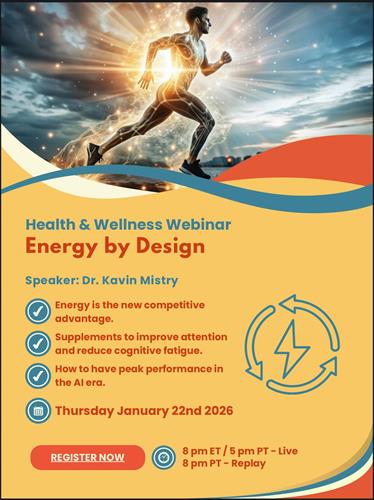
Date and Time
Thursday Jan 22, 2026
7:00 PM - 8:00 PM CST
Jan 22nd, 2026 : 7pm - 8pm
Location
Zoom Registration Link:
https://us06web.zoom.us/meeting/register/rbe0WDtTQNiK49RQJDqk8w#/registration
Fees/Admission
Free
Website
https://www.linkedin.com/pulse/energy-new-currency-2026-reset-vitality-kavin-mistry-md-w443e/
Contact Information
Priyanka Shivpuri
Send Email
Description
Energy Is the New Currency: A 2026 Reset for Vitality

If there’s one currency that controls the modern world, it’s energy. Not money. Not time. Not productivity.
Energy.Energy controls how sharp you think. How well you focus. How resilient you feel. How present you are with the people you care about.
It’s the biological foundation of ambition, creativity, leadership, and longevity.
Yet despite remarkable convenience, automation, and technological sophistication, most people feel drained all the time. Afternoon crashes are normal. Caffeine dependence is expected. Burnout is celebrated.
This isn’t a personal failing. It’s a design flaw.
The modern world is designed to extract energy from humans.Let’s learn how to reclaim it.
The Modern World Is an Energy Extraction Machine
We live in systems that extract energy from us at every level.
Cognitive extraction Endless notifications, context switching, and algorithmic feeds keeps the mind in a state of low-grade vigilance. This saps cognitive energy.
Circadian extraction Artificial light, late-night screen time, and irregular behavior patterns disrupt our circadian rhythms. When those rhythms break down, so do our mitochondria.
Metabolic extraction Ultra-processed foods, constant eating, and insulin spikes force our mitochondria to work in a state of constant overdrive. This makes energy production noisy and inflammatory rather than efficient and productive.
Psychological extraction Constant stressors, unpredictability, lack of meaning, and social comparison to others’ curated lives activate our sympathetic nervous system. This encourages our mitochondria to fly into survival mode.
The result isn’t just fatigue. It’s a gradual decline in our biological capacities.
To understand true energy, we need to dig deeper than sleep hacks or caffeine fixes.We need to go to the mitochondria.
Mitochondria Are the True Source of Energy
Every feeling of energy, clarity, and resilience comes from one tiny place.
The mitochondria.Mitochondria are the power plants of our cells, but they are also an evolutionary marvel. They are the descendants of ancient bacteria that found a symbiotic home in our cells over a billion years ago. That partnership laid the foundation for complex, multicellular life.
The basic function of mitochondria is simple. They combine fuel and oxygen to make ATP, the usable currency of energy.
But mitochondria do far more:
- Regulate cell renewal
- Regulate inflammation and immunity
- Regulate reactive oxygen species (ROS) signaling
- Communicate with the brain, hormones, and circadian clock
Healthy mitochondria produce energy efficiently. Dysfunctional mitochondria produce energy in a messy fashion, with plenty of friction, inflammation, and waste.
When our mitochondria go bad, we feel more than just fatigue. We feel foggy, irritable, unmotivated, and weak.
In many ways, aging itself is a mitochondrial disorder.The Science of Mitochondrial Optimization
Mitochondrial health is dynamic. It rapidly responds to what we do, what we eat, and how we think about life.
5 Factors in Mitochondrial Efficiency
1. Mitochondrial biogenesis Mitochondria can reproduce in response to energetic demand. Aerobic activity and interval training stimulate the hormones that help regulate biogenesis.
2. Redox balance Mitochondria need just the right amount of oxidative stress. An overly stressful environment leads to too much oxidative stress that damages mitochondrial DNA and membranes; too little stress hampers adaptability.
3. Fuel flexibility Healthy mitochondria show flexibility in using glucose and fatty acids as fuel. Insulin resistance and frequent eating lock mitochondria in an inefficient metabolic groove.
4. Mitophagy Mitochondria need to be renewed. Damaged mitochondria need to be recycled. Practices like exercise, fasting, and sleep promote mitophagy; they prevent biological trash from building up.
5. Circadian alignment Mitochondrial functions follow circadian rhythms, like all living systems. Disconnected living patterns, such as eating at all hours of the day, going to sleep and waking up whenever, interfere with mitochondria’s natural repair processes.
This accounts for a frustrating experience people face today: They sleep more but feel worse. They eat constantly but still feel drained. They “rest” but can’t get their batteries recharged.
The signals are out of sync.
Practical Strategies to Rebuild Cellular Energy
Lifestyle Principles
Move with purpose: Zone 2 aerobic training (which can also include brisk walking) and occasional high-intensity exercise stimulate the density and efficiency of our mitochondria to produce energy in a non-wasteful way. The consistency of movement patterns matters more than the intensity.
Honor light cycles: Morning light anchors our circadian rhythm; evening light keeps us from getting well-deserved sleep. Screens after dark are an especially potent metabolic disruptor.
Eat with the seasons: Time-restricted eating, periodic fasting, and metabolic off-seasons promote metabolic flexibility. These practices help reset our mitochondria; constant eating locks them into inefficient production patterns.
Stress inoculation: Hormetic practices like exposing ourselves to cold, breathwork, and purposeful challenges activate anti-fragile resilience pathways that fortify healthy mitochondria.
Targeted Supplements to Aid Energy Production
Supplements can’t fix an unhealthy lifestyle. But properly chosen supplements can support important mitochondrial pathways if they’re used along with an optimal lifestyle design for the best results.
- Rhodiola rosea: An adaptogen that enhances mitochondrial efficiency. Increases metabolic stress tolerance by activating pathways that enhance resilience to fatigue, as seen in studies with military personnel.
- Panax ginseng: An adaptogen with deep roots in Chinese medicine. Supports ATP production via multiple mechanisms; protects against fatigue; helps build energy reserves.
- Coenzyme Q10: A key part of the electron transport chain; levels decline as we age; statins deplete it.
- Acetyl-L-Carnitine: Supports fat oxidation in mitochondria; helps neurons produce energy.
- Magnesium: Needed to activate ATP; without it ATP can’t do anything.
- Alpha-Lipoic Acid: Supports redox balance in mitochondria; regulates glucose metabolism.
The goal is not stimulation. It’s efficiency.
Real energy feels calm, stable, and resilient.Energy as a Philosophy of Living
Energy is not something you chase. Energy is something you protect.
When your energy is high discipline feels easy. Focus becomes natural. Presence deepens. Purpose connects.
When your energy is low, even the best strategies fall flat.
For all these reasons, energy management underlines everything I teach in Primal Health Design and the Primal Reset Program. Long before mindset matters. Long before issues of productivity arise. Long before performance gaps show up.
Biology comes first.
And as we look toward 2026, the most important question is not how much you want to achieve in your work or your relationships.
The most important question is: “How will you design your life to create energy instead of consuming it?”Your Turn
As you look toward 2026, what is the single biggest habit or change that improves your energy levels?
Sleep? Movement? Light exposure? Nutrition? Managing stress? Supplements?
Reply here — I’d love to hear your top energy hack for 2026!
Selected PubMed References
- Amorim JA, Coppotelli G, Rolo AP, Palmeira CM, Ross JM, Sinclair DA. Mitochondrial and metabolic dysfunction in ageing and age-related diseases. Nat Rev Endocrinol. 2022;18(4):243-258. doi:10.1038/s41574-021-00626-7
- Mattson MP, Moehl K, Ghena N, Schmaedick M, Cheng A. Intermittent metabolic switching, neuroplasticity and brain health. Nat Rev Neurosci. 2018;19(2):63-80. doi:10.1038/nrn.2017.156
- Xu X, Pang Y, Fan X. Mitochondria in oxidative stress, inflammation and aging: from mechanisms to therapeutic advances. Signal Transduct Target Ther. 2025;10(1):190. Published 2025 Jun 11. doi:10.1038/s41392-025-02253-4
- Ivanova Stojcheva E, Quintela JC. The Effectiveness of Rhodiola rosea L. Preparations in Alleviating Various Aspects of Life-Stress Symptoms and Stress-Induced Conditions-Encouraging Clinical Evidence. Molecules. 2022;27(12):3902. Published 2022 Jun 17. doi:10.3390/molecules27123902
- Memme JM, Erlich AT, Phukan G, Hood DA. Exercise and mitochondrial health. J Physiol. 2021;599(3):803-817. doi:10.1113/JP278853



